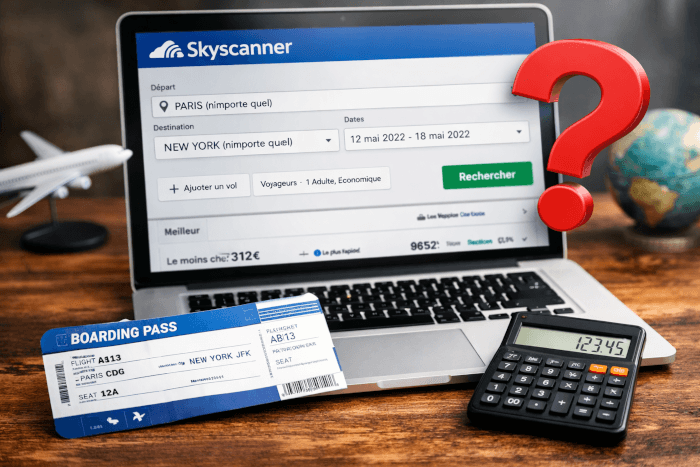
Booking a plane ticket at the best price has become a priority for many travelers. In this context, comparators such as Skyscanner are often touted as must-have tools.
But behind this promise of savings, one question keeps coming up: can we really trust them? Before answering, it's important to understand how these platforms work, and what they actually entail.
Why use Skyscanner?
Skyscanner follows the same logic as other comparators such as Opodo, Liligo or Expedia. The aim is simple: to display the various options available for a given journey in just a few seconds.
The user enters a destination, dates and departure point, often from French cities such as Paris, Lyon or Nantes. The engine then aggregates hundreds of offers from airlines and partner platforms.
This allows you to quickly view price lists, as well as compare journey times, stopovers and timetables. On paper, the tool is efficient.
How to find a cheap flight with Skyscanner?
Using Skyscanner remains accessible. All you have to do is fill in the basic information to obtain a list of flights classified according to various criteria.
Très quickly, a reality becomes apparent: the cheapest tickets are rarely the most comfortable. From certain secondary cities, such as Nantes or Grenoble, economical journeys often involve one or more stopovers.
Trèalit;e; appears.
For example, a flight from Nantes to Milan may have an attractive fare, but require a stopover in Paris and several extra hours of travel. Conversely, a faster, direct flight will generally be more expensive.
On the other hand, from major hubs such as Paris or Bordeaux, it is often possible to find direct flights at competitive prices, which completely changes the experience.
Can you really save with Skyscanner?
In principle, yes. Comparators make it possible to quickly identify price points and avoid paying too much for a ticket.
Skyscanner is a great way to save money.
But in practice, savings depend very much on the type of trip. The prices displayed first are often the lowest, but they don't always reflect the final cost.
At the end of the day, it's all about the bottom line.
Some users notice discrepancies between the displayed price and the one offered at checkout. This can be explained by price updates or by intermediaries adjusting their offers in real time.
Some users find differences between the rates displayed and those offered at the time of payment.
The limits of flight comparators
The main sticking point remains transparency. Skyscanner doesn't sell tickets directly, it redirects to partners. And it's at this point that experience can vary.
The main sticking point is transparency.
In some cases, the price increases slightly when the deal is finalized. In other cases, additional charges may apply, for example on checked baggage or certain services.
In some cases, the price will increase only when the booking is finalized.
This approach is not specific to Skyscanner, but it is still common among comparators. Low-cost airlines, which are often promoted for their attractive fares, also charge for optional extras, which can add to the bill.
This is not a specific Skyscanner feature, but is common on comparison sites.
Is Skyscanner reliable?
Skyscanner remains a reliable tool for quickly comparing options and getting an idea of market prices. It saves time in the research phase.
On the other hand, it should not be considered as a complete solution. The user must remain vigilant at the time of booking, and check the exact terms and conditions proposed by the final service provider.
The user must remain vigilant at the time of booking, and check the exact terms and conditions proposed by the final service provider.
The user must remain vigilant at the time of booking, and check the exact terms and conditions proposed by the final service provider.
In other words, Skyscanner is a good starting point, but not always the best arrival point.
Are there simpler alternatives?
Faced with these limitations, some travelers prefer to use solutions that directly simplify the search. Rather than comparing dozens of options, the aim becomes to find an optimized itinerary without multiplying the number of intermediaries.
Faced with these limitations, some travelers prefer to use solutions that directly simplify the search process.
This is particularly true of platforms such as Flylooping, which offer a different approach. The idea is not to compare flights one by one, but to build a coherent itinerary, with no hidden costs and no loss of time.
Flylooping is a platform that offers a different approach.
This type of approach makes for greater clarity and avoids unpleasant surprises at checkout.
Conclusion
Skyscanner remains a useful tool for exploring prices and identifying opportunities. It fulfils a simple need: to quickly compare flights.
But to book effectively, it's essential to go further than a simple comparison. Understanding conditions, anticipating costs and choosing the right solution for your needs will help you avoid the classic mistakes.
At the end of the day, it's all about making the right choice.
In the end, it all depends on your objective. Are you looking only for the lowest price, or for a smooth, controlled experience from start to finish?
At the end of the day, it all depends on your objective.

